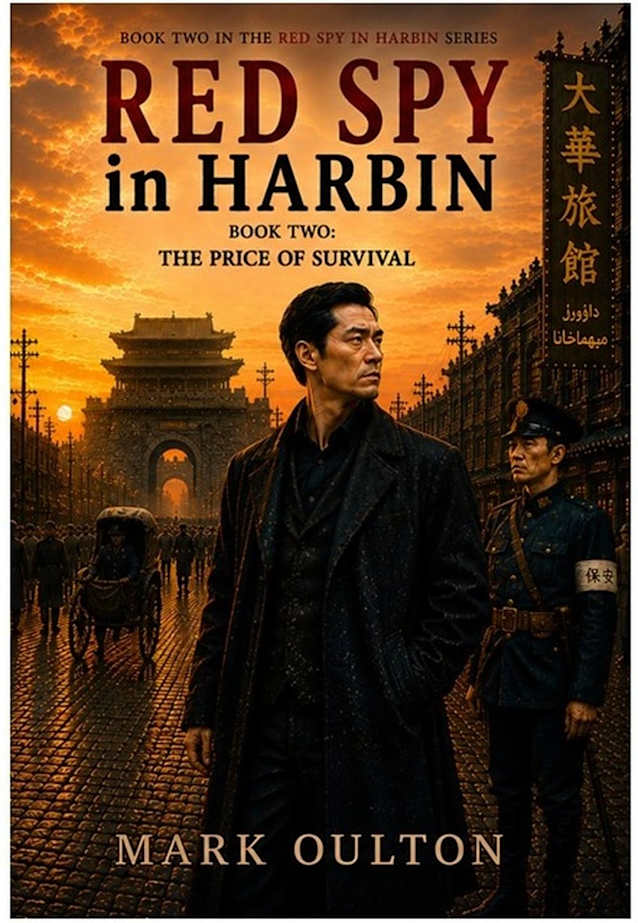
Red Spy in Harbin: Book 2: The Price of Survival (The Red Spy in Harbin Series 1)
About
The Price of Survival
China, 1938.
Japan’s invasion has united China’s Nationalists and Communists against a common enemy. While armies wage war on the battlefield, intelligence officer Chen Minghe fights in the shadows. When he discovers a Nationalist spy operating at the heart of the Communist movement, circumstances lead to her disappearance from public view. The result is a unique intelligence asset whose influence will extend far beyond the war against Japan and into the struggles that follow.
What begins as a single operation draws Chen into a hidden world of spies, coded messages and clandestine networks. From the caves of Yan’an to the international intrigue of British Hong Kong, neutral Macau and the dangers of Japanese-occupied Taiwan, he helps build intelligence networks capable of gathering information, conducting sabotage and striking at the machinery of occupation.
As the war expands across East Asia, the operation unexpectedly brings Communist intelligence into contact with elements of British intelligence, creating an alliance of convenience between individuals united by a common enemy but uncertain what the future may bring.
In Taiwan, the challenge is different. Operating under Japanese rule, Chen helps identify former university students whose interest in Marxist ideas has survived into adulthood and survived the attention of Japan’s ruthless security services. Now scattered across the island as teachers, civil servants, journalists and professionals, they possess access and local knowledge unavailable to outsiders. Carefully compartmentalised and often unaware of one another’s existence, they become part of a clandestine intelligence network whose impact will be felt long after the Second World War has ended.
Yet the war is fought on more than one front. While Chen operates in the shadows, his wife Daxia serves the Communist cause in her own way as a signals intelligence specialist. Bound by the secrecy of intelligence work, husband and wife cannot discuss their operations, even with each other. Their work brings periods of separation and uncertainty, forcing both to accept that service to a cause often comes at a deeply personal cost.
As the conflict spreads across East Asia, Chen’s world expands far beyond the Communist movement itself. Smugglers ferry agents and information across dangerous waters, a master forger creates identities, contacts within Nationalist territory facilitate movement across hostile regions, and figures from Taiwan’s criminal underworld prove unexpectedly useful allies. Alongside them are British intelligence officers pursuing their own objectives. Bound together by necessity rather than ideology, each plays a role in the hidden struggle against Japanese expansion. Yet as the war draws to a close, some begin to look beyond Japan’s defeat and towards the political struggles that will shape Taiwan’s future under its next rulers.
But wartime alliances are rarely permanent. The intelligence networks Chen helps create are built to defeat a common enemy, yet the information they gather will one day be turned against former allies. As Japan’s empire begins to crumble and the Second World War draws to a close, old rivalries re-emerge and the future of China and Taiwan hangs in the balance.
Drawing upon real historical events, The Price of Survival is a sweeping tale of espionage, intelligence, sabotage, sacrifice and survival during one of the twentieth century’s most turbulent eras. Combining historical authenticity with the tension of a spy thriller, it is the second volume of the Red Spy in Harbin trilogy and continues Chen Minghe’s remarkable journey through revolution, war and the hidden battles fought beyond the front lines.
For readers who enjoy Alan Furst, John le Carré, Frederick Forsyth and Philip Kerr, The Price of Survival offers an immersive journey into the secret world of wartime intelligence in East Asia.